Page 5 of 10
Posted: Mon Mar 10, 2008 9:51 pm
by Sky
We've had masses of mushrooms on our land in the last few weeks, don't know if it's the time of year in NZ for them or that all the rain has made them grow.
Lots of field mushrooms and some others that are huge and rougher on the top with a stronger taste, the hubby called them horse mushrooms.
My camera is broken so I can't show you the huge pile I picked this morning .... I've been washing them, drying them and then slicing them putting them in freezer containers and popping in the freezer to use later.
I tried puff ball here and it's lovely fried with a bit of butter and garlic but we don't get them on our land and I've not been to the place where I last found them for a while now.
I don't think I'd eat any other kinds of mushroom in NZ though as I think there are a few very deadly ones.
Posted: Thu Jun 05, 2008 3:44 pm
by Lady Willow
any idea what these are please ... (I'm not eating them, just curious)


Re: We try will ID your mushrooms here
Posted: Mon Aug 11, 2008 5:37 pm
by Andy Hamilton
ooh could be a lot of things er and looking at the date you posted they won't be around now. Do they have gills or pores, where did you find them? As much information as possible helps when identifying. Could be clitocybe vibecina but can't be certain and I think it is the wrong time of year, normally around in the autumn. Can't you take them to the chemist in france to identify them? Or is that a really old thing that used to happen and does not any more?
Re: We try will ID your mushrooms here
Posted: Mon Aug 11, 2008 9:05 pm
by Mrs Moustoir
Our local pharmacist still does the fungi identification - but in my experience, he tends to look in his book and say "I think it is a xxxxx......don't eat it."
Re: We try will ID your mushrooms here
Posted: Wed Nov 19, 2008 1:30 pm
by lubeyblue
Hello....I'm new to this site and found it while trying to find out about some mushrooms growing in my garden. I'm dying of curiosity and would love help working out what they are. I've looked at Rogers mushrooms online but as a total novice am getting a bit confused. Hopefully my photos are underneath.....They're growing in my lawn, under the oak tree next to some shrubs. White gills undrneath, no real smell, not sure what else to say really. I've got lots more pics but no time at the mo to fiddle with them so they can be posted. Many thanks for any help anyone can offer!

- mushrooms 008.jpg (225.25 KiB) Viewed 13194 times
Re: We try will ID your mushrooms here
Posted: Mon Nov 24, 2008 7:53 pm
by maxmg
lubeyblue wrote:White gills undrneath, no real smell, not sure what else to say really. [/attachment]
You need to describe the gills: decurrent, adnate, etc (that online site you mentioned will explain what those terms mean). Is the cap brittle? That could be a russula, for instance. What colour is the stem? Does it bruise or stain when cut. If you cut a cap off and place on paper you can get a spore print that will help. Do the gills exude milk when damaged?
Re: We try will ID your mushrooms here
Posted: Wed Nov 26, 2008 2:42 pm
by lubeyblue
Hello,
right ho, will go and have a look, back later.....
Re: We try will ID your mushrooms here
Posted: Sun Dec 28, 2008 2:31 pm
by Bev_B
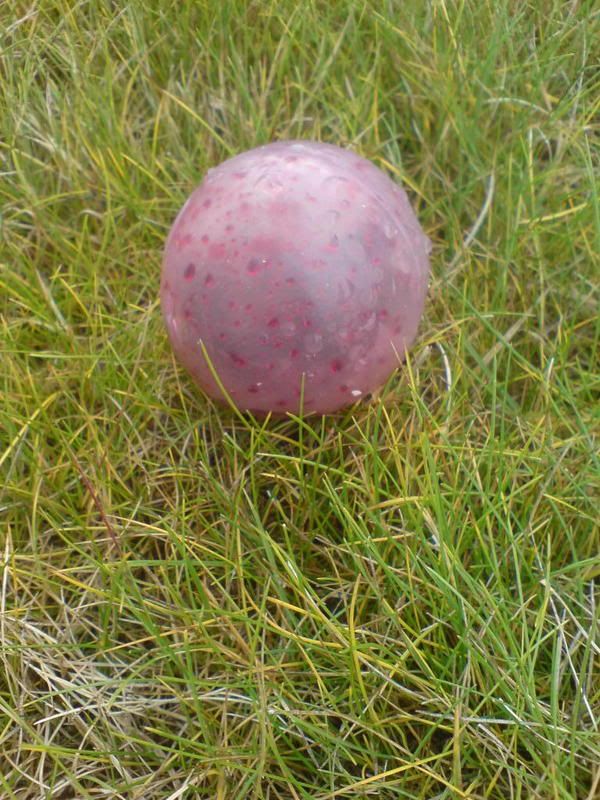
This was growing in my garden a couple of weeks ago (new turf two years ago), I thought it was a kids ball until I knocked it and it bruised so put it back in place and took a pic with my phone:
Re: We try will ID your mushrooms here
Posted: Wed Sep 09, 2009 9:02 am
by ndyuk
I found several of these mushroooms clustered together in a conifer/pine forest, sandy soil. I tried collecting the spore deposit, but I feel I did something wrong??? After leaving the cap under a glass, half of it on white paper, half of it on black, I had collected no spores after 3 hours. Checking it this morning however, it had left a black residue on the white paper where a damaged section of the mushroom had been laying (Are these the spores? I am a beginner). Its diameter is aprox. 5 cm and it stood about 10 cm off the ground. It is creamy white in colour with shades of light brown on the top. It has true gills which are very thin.
Re: We try will ID your mushrooms here
Posted: Wed Sep 09, 2009 9:11 am
by ndyuk
This is the 2nd lot of mushrooms found. I unfortuantly have less detailed info about this lot but will do my best. Found in conifer wood, sandy soil, growing near logs but not on, around 7 - 10 cm in diameter and 10 cm in height off ground. Colours as seen in pictures. Did not take a spore deposite I am afraid.
Re: We try will ID your mushrooms here
Posted: Fri Oct 23, 2009 3:38 pm
by PR_1973
Hello all, I wondered if you could help me.
I have two clusters of mushrooms that have spung up in my back garden on the lawn. They appear to be of the same type, but one cluster seems to be slightly more mature than the other.
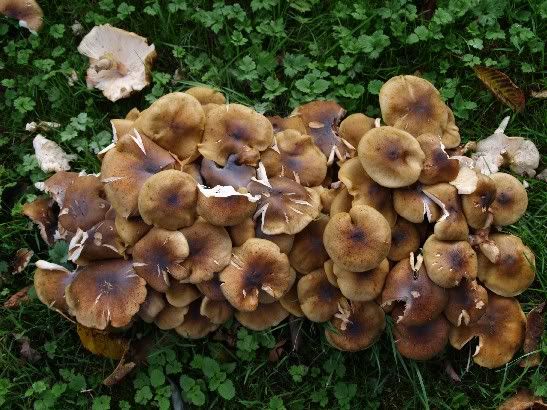
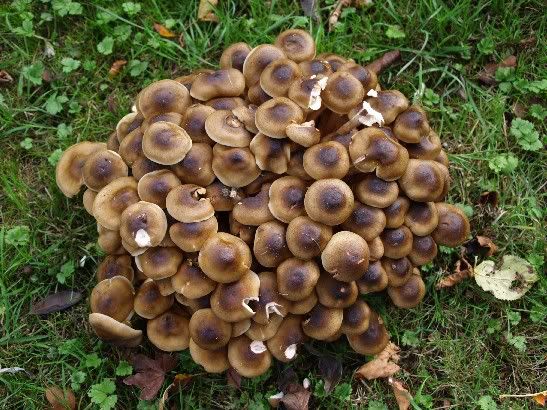
I have also taken a picture of the top and bottom views of one of the more mature ones.
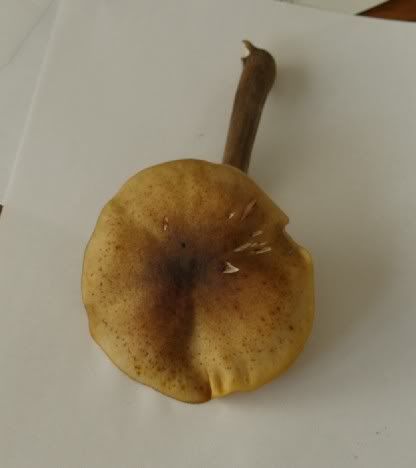
As you will see it’s a tawny brown colour with a darker patch towards the centre of the cap and small brown speckles.
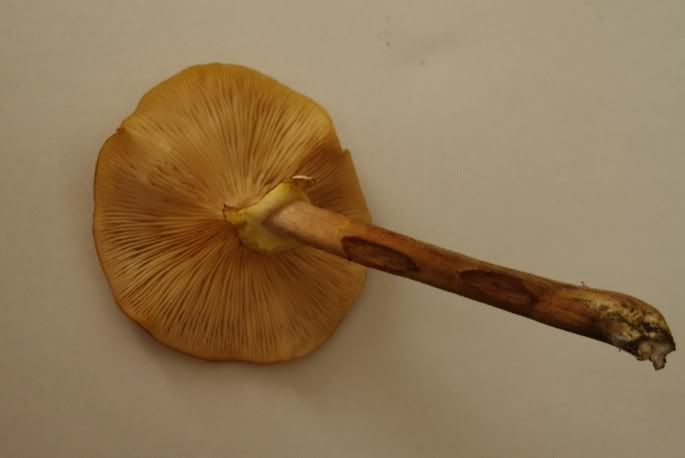
Other information.
Dimensions. The pictured mushroom has a diameter of 7cm and the stalk length is 12 cm.
Spores – I tried to knock a few out from the gills, the appear to be brown (when I have zoomed all the way in on the picture taken with my camera), but I can’t be absolutely sure, they are tiny.
Stem – as per the picture. Long and thin with a sort of collar about 1cm from the mushroom cap (is this what you call a “ring”).
Other info: The mushroom is not slimy at all – quite brittle I’d say. It smells like the sort of mushroom you’d buy at the shops.
Can anyone identify the type and whether it is safe to eat?
Thanks in advance.
P.
Re: We try will ID your mushrooms here
Posted: Fri Oct 23, 2009 7:51 pm
by fungi2bwith
They are honey fungus. They are good to eat. The caps only are normally eaten as the stems are too firm and dry. They need to be well cooked (poisonous raw). There are some reports that they still cause mild poisoning even when cooked but there is unlikely to be a problem as they are sold in every market in Italy at this time of year. However, best to be careful and eat only a little at first. There are lots of sub-species of honey fungus and maybe only some varieties affact some people. Also don't take absolute notice of people like me on forums, check your mushroom characteristics with books or on-line resources.
There have been huge numbers of these mushrooms this year.
PS
These may well be killing your trees in your garden.
Re: We try will ID your mushrooms here
Posted: Sat Oct 24, 2009 9:06 am
by Andy Hamilton
They are not edible by everyone, they are one I have not taken a risk with as it goes. They can cause some people who are susceptible to go into shock and be hospitalised. I would say treat with caution.
Re: We try will ID your mushrooms here
Posted: Wed Oct 28, 2009 12:38 pm
by Cheezy
Went on a fungus forage and we found loads of Honey fungus (in fact thats about all we found). The local guide (Dr Keith Thomas, Of Sunderland Univ microbiology, but more important the Brewlab course and co founder of Darwin Brewery!) said all fungus can have adverse reactions with people and some varieties more than others, this is not poisoning but an intolerence to that particular fungus.
You should treat all fungus with caution if you've never eaten it before. This is also the case with common "edible" ones
In the case of Honey Fungus 1 in 10 will be intolerent
With me believe it or not it's Shitake mushrooms.
We ate the Honey fungus with no problems, though they are a delicate flavour and not very shroomy at all. So you might be better finding something else.
Re: We try will ID your mushrooms here
Posted: Sat Nov 07, 2009 1:40 am
by Geoff
ndyuk wrote:This is the 2nd lot of mushrooms found. I unfortuantly have less detailed info about this lot but will do my best. Found in conifer wood, sandy soil, growing near logs but not on, around 7 - 10 cm in diameter and 10 cm in height off ground. Colours as seen in pictures. Did not take a spore deposite I am afraid.
I think this is
Collybia maculata.